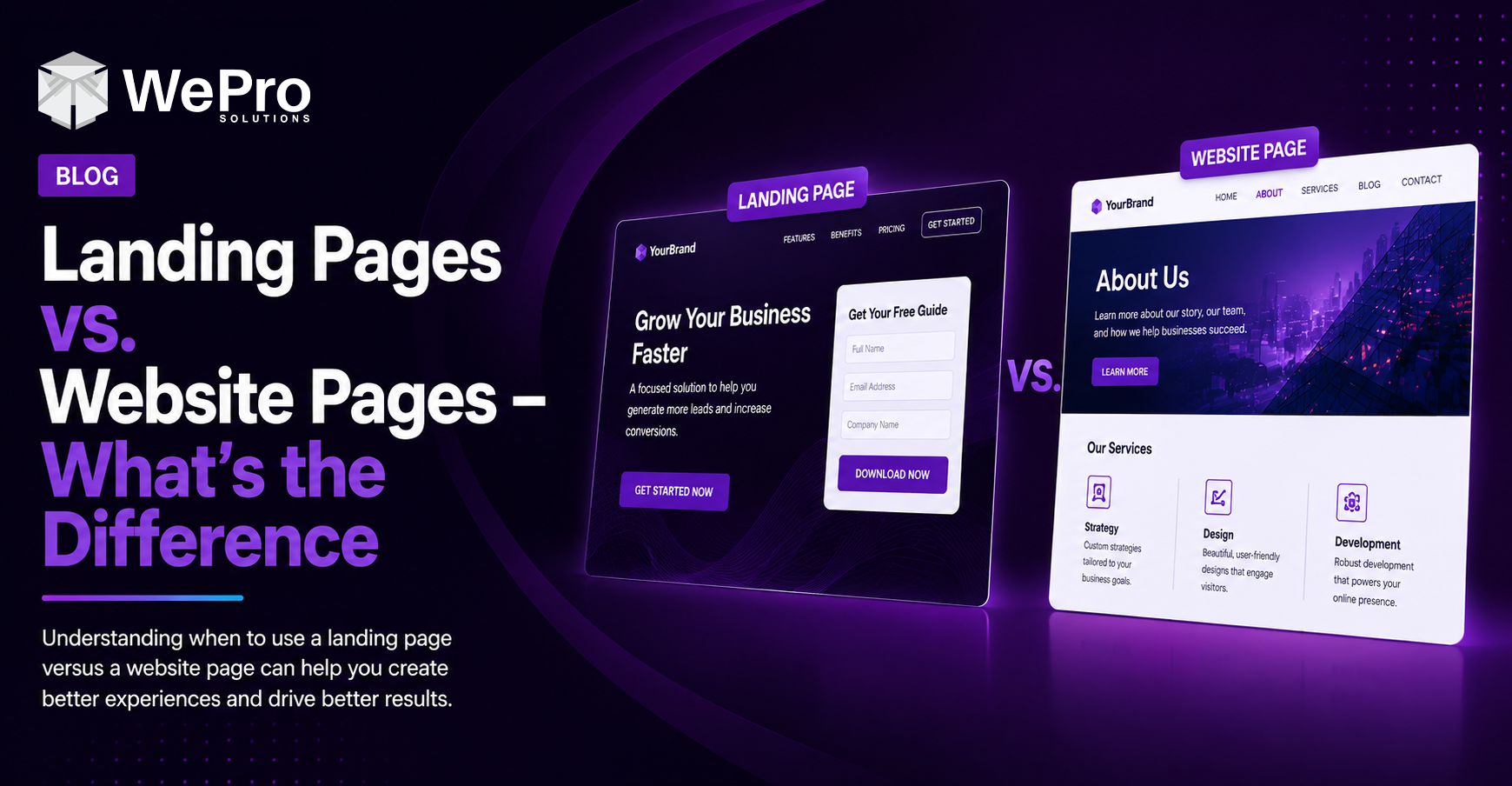
When you’re building your website, some pages are no brainers. The home page, about, services, those are all important and serve a specific purpose for your site and your audience. But what about landing pages?
A common misconception about websites is that landing pages and website pages are the same – that they both live on your site and serve the same purpose. While this is partially true, they aren’t really the identical.
To put it simply, website pages are designed to help people learn more about your business – to explore what you do and what you have to offer them. Landing pages are designed around a specific goal or action – to make a purchase, sign up for something, move them along in their customer journey.
Understanding the difference between the two – and choosing the right one for your needs – can have a much higher impact on your goals and digital success.
Let’s break down landing pages versus website pages and help you better recognize when you should use each one.
A website page is what you typically think of when clicking through a website – the home page, about us, services, contact, blog, etc. These pages are designed and developed to match the brand identity of your company and site while providing standing information to your target audience. They’re used to make up the broader scope of your online identity – showcasing who your company is to the world and what your business is all about.
A website page is primarily there to be part of your overall website and all the components of it. Because of this, website pages typically have a few key elements or purposes:
All together, a website page is focused on telling the story of your company.
A landing page is a standalone page built for a digital marketing purpose – to get the visitor to take a specific action that the page is designed around. Rather than being part of your main website structure, people find the page through a particular link and path – such as a Google search, email, social media post, or paid ad.
The page is designed to match your company’s branding, but it doesn’t have to fit the same aesthetic as your main site. Many of the typical website features – like a full menu and footer, are removed to keep people dialed in on completing the desired action. Some common actions these pages focus on include:
These pages allow you to focus more directly on certain digital marketing efforts and audience segments to help you reach your goals.
At their core, the difference between a landing page and a website page lies in their purpose. A website page is there to inform and guide a visitor – to teach them more about your company and lead them down a path that keeps them engaged and builds a relationship. A landing page is meant to convert – to turn an initial click into a desired action.
Because of these differences, the audience is also typically different for each page. Website pages are meant to cater to a broad audience, while landing pages are geared toward a specific target audience that your campaign or marketing strategy is focused on. Similarly, how those audience members get to each page is different. Website pages are typically found through searches (direct or indirect) and referrals, whereas landing pages are usually part of a campaign – emails, social media posts, ads.
Here’s an at-a-glance breakdown:
Despite being different, both landing pages and website pages serve a purpose and help companies achieve their digital goals – which one to use just depends on the time and place.
If you’re looking to gain awareness and attention, a website page is your best bet. Since this is where people typically learn about your company, services, and products, a website page is good for starting a relationship and grabbing people’s attention.
Some ideas of when a website page is the better play:
These are strong, important pages to display on your website consistently because they tell the world who you are, what you do, and what you can offer them.
If you’re wanting people to do something specific, a landing page is your best bet. The link comes from a campaign effort (emails, social media posts, paid ads, etc.), and the design points toward a call to action, all leading people to a certain activity.
A few ideas of when a landing page makes the most sense:
These pages remove distractions and guide visitors exactly where you’re wanting them to go, making it easier for them to partake in the action you’re hoping for.
For many businesses, using landing pages and website pages together creates a more well-rounded digital presence that can help you gain more visitors, build stronger relationships, generate new leads, and create more conversions.
Website pages build understanding and credibility in your business while also establishing your SEO visibility, and landing pages turn targeted traffic into results.
Think of it this way – you might have a general website page about your car washing services that lives on your site and allows people to learn about what exactly you do, how much it costs, and more. Then you might have a landing page that focuses on your exact location and promotes a free membership.
By utilizing both types of pages, you can establish a stronger digital presence that achieves all your goals.
When it comes to your website, landing pages and site pages aren’t an either-or decision. Instead, they’re a joint force where each piece is designed to do different things. By understanding what you’re trying to accomplish with a page, you can decide on the best type for your business.
When your website and landing pages work together, you can create a digital experience that not only tells people who you are but also gives them a clear path to take the next step.
Even if you understand the difference between website pages and landing pages and know which one you’re looking to build, actually creating those pages is still a process. As a website design and development company in Texas, we help businesses create pages and websites that they’re proud to show off to the world.
Whether you’re needing a refresh on your website pages, considering landing pages for a new campaign, or a mix of both, our team is here to help you get the job done! Send us a message and we’ll schedule your free consult.